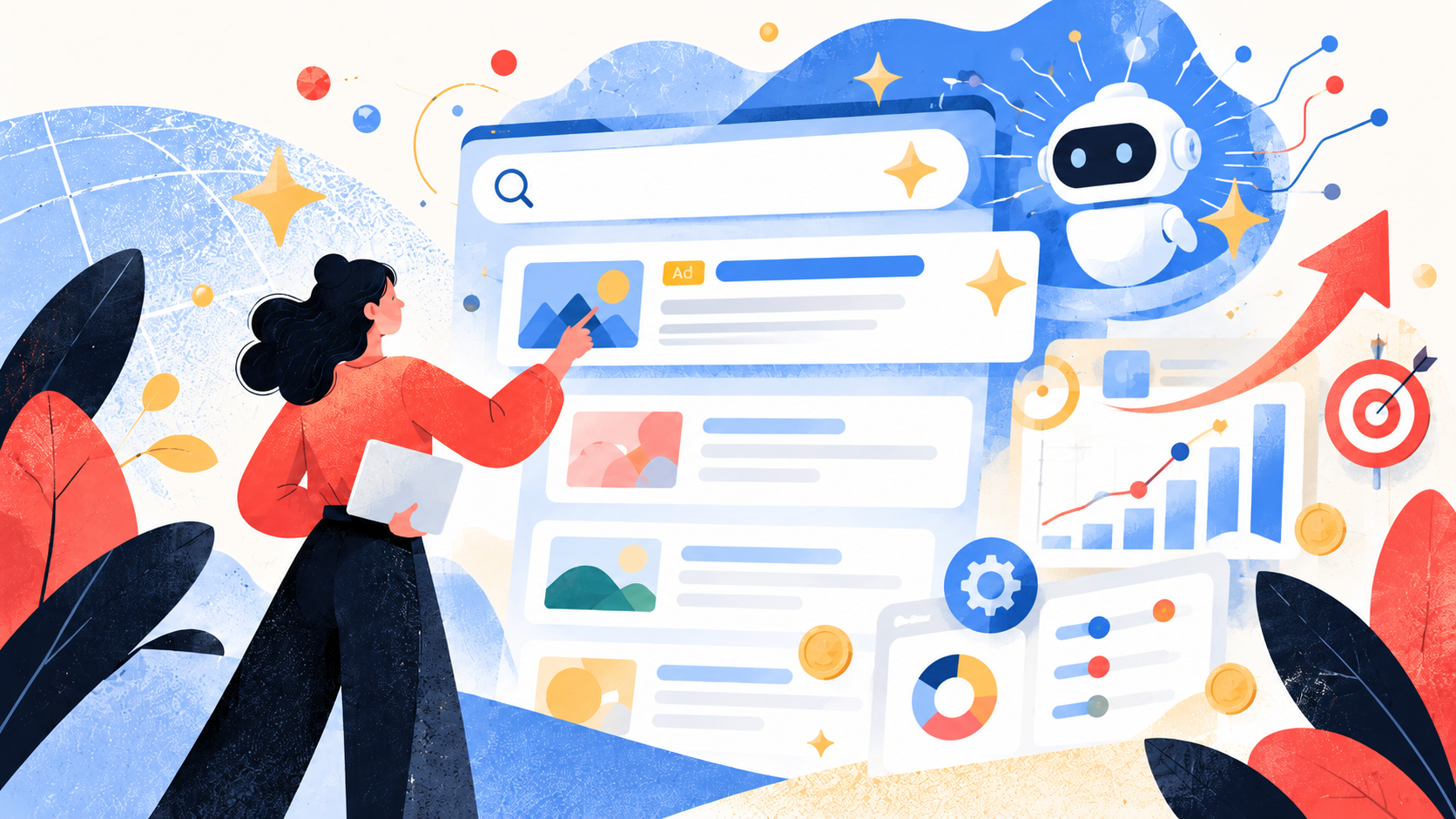
Search advertising is becoming less manual and more interpretive. For years, advertisers spent much of their time building keyword lists, adjusting match types, changing bids, and writing multiple ad variations. Those skills still matter, but platforms such as Google Ads are increasingly asking advertisers to provide strong goals, assets, landing pages, and conversion signals while AI handles more of the matching and optimization.
AI Max for Search is part of this transition. It expands the system’s ability to interpret user intent, understand landing-page content, create or adapt assets, and identify relevant searches beyond a narrowly controlled keyword list. For businesses, this creates both an opportunity and a risk: campaigns can discover more demand, but weak inputs can also be scaled more efficiently.
Keywords Are Becoming Guidance, Not Absolute Boundaries
Traditional paid search was largely based on controlling which queries could trigger an ad. AI-driven campaign structures increasingly use additional signals, including page content, account history, audience context, creative assets, and conversion data. That allows the platform to connect an advertiser with searches that may be highly relevant even when the exact phrase was never manually added.
This does not mean advertisers should stop thinking about keywords. It means keyword strategy becomes one component of a broader intent strategy. The marketer’s job is to define the market, the offer, the customer problem, and the value proposition clearly enough that the system can make useful decisions.
Automation Cannot Fix a Weak Offer
If a landing page says only “We provide innovative solutions for modern businesses,” no amount of AI optimization can turn that statement into a strong commercial proposition. The system may find more people, but it cannot invent a reason for them to buy.
A strong offer should answer three questions quickly: What do you do? Who is it for? Why should someone choose you instead of ignoring the ad? For example, “B2B lead generation for professional-service firms that need qualified sales appointments” gives both the platform and the visitor far more useful context than “Grow your business today.”
Landing Pages Matter More as Campaigns Become Smarter
AI-driven advertising systems increasingly analyze the destination itself. That makes dedicated landing pages more important, not less. A company offering SEO, video production, Google Ads, and research marketing should not send every visitor to the same generic homepage.
Separate pages help align message, intent, and conversion action. Someone searching for “Google Ads management” should land on a page that discusses paid search strategy, campaign structure, tracking, reporting, and expected outcomes. Someone searching for “corporate video production” needs a completely different message.
A strong landing page should include:
- A clear headline tied to the user’s problem.
- A concise explanation of the service and ideal customer.
- Proof such as case studies, testimonials, or experience.
- A specific call to action.
- Fast mobile performance and clean tracking.
Conversion Quality Is the Real Fuel
One of the most important changes in AI advertising is the growing importance of conversion quality. If the platform is told that every form submission is equally valuable, it will optimize toward form submissions. That can create campaigns with attractive cost-per-lead numbers but poor commercial performance.
The stronger approach is to connect advertising with CRM outcomes. A lead can move from new inquiry to qualified lead, sales opportunity, customer, and repeat customer. When those deeper outcomes are returned to the advertising platform, the optimization system receives a far more meaningful signal.
The Marketer’s Role Is Moving Up the Value Chain
As platforms automate more tactical work, marketers need to spend more time on the parts that cannot be solved by a bidding algorithm: market understanding, positioning, offer design, creative strategy, measurement, customer research, and commercial interpretation.
That is a positive development for skilled marketers. Adjusting bids by a few percentage points was never the highest-value part of the job. Understanding why a customer chooses one business over another is far more important.
Use AI Max With Control, Not Blind Faith
Automation should be monitored like any other marketing system. Review search-term insights, check which landing pages receive traffic, compare lead quality by campaign, watch geographic performance, and audit conversion tracking regularly. The objective is not to resist automation but to make sure it is optimizing toward the right business outcome.
The future of search advertising is not human versus machine. It is experienced marketers using machine intelligence with better inputs, stronger strategy, and stricter measurement. Businesses that understand this will gain more from AI Max than those that simply switch it on and hope for the best.
Muhammad Al Ori
Business Development and Marketing Strategy